Asm. Mia Bonta’s AB 801 Targets Lending Bias
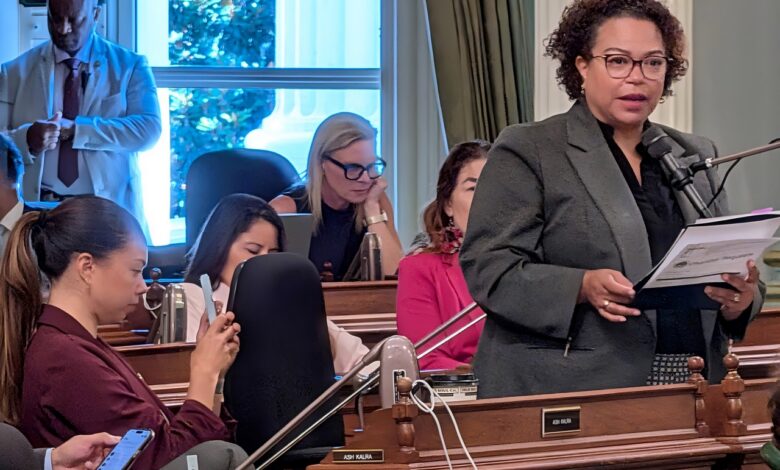
Asm. Mia Bonta’s AB 801 Targets Lending Bias and California’s Persistent Racial Homeownership
Antonio Ray Harvey | California Black Media
Communities of color in California continue to face significant obstacles to buying and owning homes, along with gaps in government enforcement of fair-lending laws that limit their ability to build wealth proportionate to their share of the state’s population.
That’s why Assemblymember Mia Bonta (D-Alameda), Chair of the Assembly Health Committee, said she introduced Assembly Bill (AB) 801 in February 2025 specifically to address those disparities impacting communities of color and low-income neighborhoods. The bill is backed by the California Legislative Black Caucus (CLBC).
The bill, known as the California Community Reinvestment Act, if passed and enacted, would mandate financial institutions – including state-chartered banks, credit unions, and independent mortgage companies, to actively meet the credit needs of all communities where they conduct substantial business, prioritizing low- and moderate-income areas.
“The Reinvestment Act creates more transparency around our ability to understand whether or not (financial institutions) in the state are actually providing mortgages in Black and Brown communities to buy houses,” Bonta told California Black Media (CBM).
In addition to gaps in oversight, people living in economically disadvantaged neighborhoods in California face severe barriers to acquiring mortgage credit due to a combination of factors, including high property values and rigid underwriting standards.
The bill expands state-level oversight of financial institutions to ensure they actively reinvest in the historically underserved neighborhoods they serve, explicitly addressing the root causes of the racial wealth gap and predatory or discriminatory lending.
AB 801 also establishes rules that require the Department of Financial Protection and Innovation (DFPI) to examine these lenders for compliance at least once every four years.
“We’re in a position right now where we know there’s a disproportionate number of Black and Brown people who don’t have the ability to get credit from banks to buy their dream home,” Bonta said. “This bill will allow us to hold banks accountable to understand the extent to which they are actually providing loans to Black and Brown communities over time.”
AB 801 was first introduced to the California Legislature on Feb. 18, 2025. Bonta made it a two-year bill in the Senate to provide additional time to educate lawmakers on the legislation and address pushback from credit union groups. The bill last passed the full Assembly on June 3 with a 45-15 vote.
On June 17, 2026, the bill passed out of the Senate Banking and Financial Institutions Committee with a 5 -2 vote. On June 30, the Senate Judiciary Committee voted to advance AB 801 with an11-2 vote. Now, the bill awaits its fate in the Senate Appropriations Committee after the legislature returns to the State Capitol on Aug. 3.
Bonta told the Senate Banking and Financial Institutions Committee that it was the California Task Force to Study and Develop Reparation Proposals for African Americans that called on the legislature to take structural action to address the ongoing economic harm caused by housing discrimination.
“This is the part of that response that we can focus on today. Since 2015, the Black and Latino borrowers have received conventional mortgage loan originations at roughly half the rate of White borrowers in California,” Bonta said. “The homeownership gap between Black and White Americans today is approximately what it was before the Fair Housing Act passed in 1968.”
AB 801 is primarily backed by civil rights groups, consumer protection advocates, and fair housing organizations aiming to prevent lending discrimination in communities of color.
The African-American Credit Union Coalition (AACUC) expressed concern that the bill undermines the unique structure of credit unions. AACUC is a non-profit organization dedicated to increasing diversity, equity, and inclusion (DEI) within the credit union movement and closing the racial wealth gap.
California Community Banking Network (CCBN) worked with the California Bankers Association (CBA), the California Credit Union League, Mortgage Bankers Association, and others to advocate in opposition to AB 801.
CCBN and CBA wrote in a June 5 letter addressed to the Senate Judiciary Committee, chaired by Sen. Tom Umberg (D-Santa Ana), stating that AB 801 “risks driving up costs for consumers already struggling to afford a home.”
“AB 801 would require additional examinations and reporting obligations covering many of the same issues already evaluated through existing supervisory processes.
Although the bill contemplates consideration of examinations performed by other regulators, it does not eliminate the possibility of duplicative reviews, conflicting findings, or repetitive requests for information.”
On June 17, Rob Wilson, executive vice president for California’s Credit Unions, said AB 801 was “in a better place than it was last year,” but “we do still have some concerns with the bill.”
Wilson leads the organization’s strategic direction, advocacy, and state government affairs, working directly with lawmakers and credit union leaders.
“AB 801 creates a new regulatory framework that we believe is unnecessary and duplicative of existing oversight,” Wilson told the Senate Standing Committee on Banking and Financial Institutions. “We believe it may create some significant legal concerns, compliance, and most notably, cost concerns for California state-chartered credit unions.”
In 2024, a minimum annual income of roughly $221,200 was required to qualify for the statewide median-priced single-family home, costing approximately $865,000 to $875,000, according to the California Association of Realtors (CAR).
In 2025, the median income for Black households in California hovered around $70,220 to $73,102. Only about 10% of Black households in the state had the minimum qualifying income required to purchase a median-priced home.
Max Vargas, president and CEO of Greenlining Institute, told the Senate Standing Committee on Judiciary that “Without an examination structure, California’s fair lending protections exist on paper, but not in practice,” he said.
Founded in 1993, the Greenlining Institute is an Oakland-based policy, research, and leadership organization dedicated to racial and economic justice. Its mission is to fight the legacy of redlining practices while at the same time bringing investments and economic opportunities to marginalized communities of color.
Vargas shared that Greenlining analyzed the Home Mortgage Disclosure Act data and discovered that 37 million mortgage applications submitted between 2018 and 2024 revealed that Black borrowers were 78% more likely than White borrowers to be denied at the final underwriting stage.
“Our families in California are already facing rising costs, growing financial instability, and fewer pathways to building wealth,” Vargas said. “This is on top of federal deregulatory efforts. If California does not act, these gaps will grow and deepen.”