California Black Civil Rights Leaders Mobilize to Defend Voting Rights
Solomon O. Smith | California Black Media
Black voting rights advocates in California convened virtually Aug. 28 after a federal court temporarily blocked new U.S. Postal Service restrictions on mail ballots, a ruling civil rights leaders described as an important but temporary victory ahead of the November election.
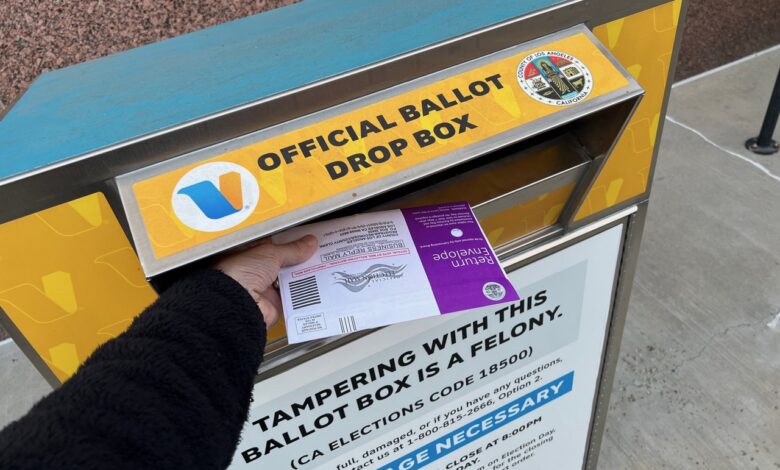
The restrictions are tied to President Donald Trump’s Executive Order 14399 and the Postal Service’s “Ballot Mail for Federal Elections” rule. Among other requirements, the rule calls for election officials to use a federal portal and comply with new standards for federal ballot-mail envelopes. A federal judge issued a 14-day temporary restraining order blocking key provisions while the court considers a request for a preliminary injunction.
Rick Callender, president of the California-Hawaii State Conference of the NAACP, said the dispute is part of a broader challenge to mail-in voting and warned against allowing the Postal Service to interfere with states’ administration of elections.
“The bottom line here is that the postal office should deliver ballots, not decide who receives one or which votes do not count,” Callender said. “We’re going to fight this attack at every point; at the mailbox, on the voter rolls and in the protection of personal data.”
The postal dispute comes as California is already engaged in another federal legal battle over voter information. In United States v. Weber, Secretary of State Shirley Weber refused to provide the federal government with the state’s full, unredacted voter-registration list, citing privacy concerns and state and federal law. The League of Women Voters of California, the NAACP and the ACLU intervened in that case in support of California. A federal judge dismissed the lawsuit in January, and the U.S. Department of Justice appealed.
Dora Rose, deputy director of the League of Women Voters of California, emphasized during the Aug. 28 meeting that the latest ruling involving the Postal Service provides only temporary relief. She said the “USPS restrictions are blocked” for now and called the decision an “important victory.”
Other speakers raised concerns about how changes to voting procedures could affect Black women, young voters and other communities that rely on early and mail-in voting. Lisa Gauthier, a San Mateo County supervisor and leader with Black Women Organized for Political Action, described Black women’s vote as a “decisive political force.” Sa’un Bell of Power California and Kristin Nimmers of the California Black Power Network discussed efforts to keep young voters informed and encourage early voting.
Lisa Holder, president of the Equal Justice Society and a civil rights attorney said,“Frankly, we are here to sound the alarm that the segregationists are attempting to steal California elections.” “They are targeting a theft of the Black and minority vote.”
Not everyone in California opposes stricter voting requirements. Assemblymember Carl DeMaio (R-Escondido) supports Proposition 39, a measure on the Nov. 3 ballot that would require government-issued identification for in-person voting and additional identifying information for voting by mail. It would also require election officials to verify voters’ citizenship.
First Assistant U.S. Attorney Bill Essayli has also defended the administration’s election policies and alleged that noncitizens are improperly registered to vote in California. California requires applicants to affirm under penalty of perjury that they are U.S. citizens before registering to vote. Election officials also verify signatures on vote-by-mail ballot envelopes.
Carmen-Nicole Cox, founder and president of The Cox Firm for Law and Policy, moderated the virtual meeting and closed with a practical message for voters: despite the ongoing legal challenges, voting by mail remains available.
“Black folks ain’t never won anything that didn’t benefit everyone else, and so we want you all saying that, and we definitely want you all saying you can still vote,” Cox said. “Voting by mail persists.”