Ohio State’s Coaches Forgot Theirs.
By Jason Burrell| South Bay Black Journal
LOS ANGELES — On Halloween night, USC finally dressed up like a Big Ten powerhouse with College Football Playoff ambitions. But unlike most costumes, this one came with something real: physicality, toughness, and an attitude that second-ranked Ohio State wasn’t prepared to match.
A week after managing just seven points in a 24-7 loss at Wisconsin, the Trojans looked like a different football team Saturday night at the Los Angeles Memorial Coliseum. They started fast, ran the football with purpose, blocked with conviction, and played defense with an urgency that had been missing far too often under Lincoln Riley.
USC didn’t dominate every statistical category or control both lines of scrimmage throughout the night. Ohio State gained more yards, ran more plays, and controlled the clock. But the Trojans made the plays that mattered, earning a 30-18 victory over the nation’s No. 2 team in front of 70,810 spectators.
It was arguably the most convincing display of physical football USC has produced during Riley’s tenure.
That raises a question worth asking before anyone starts discussing championships.
Where was this team last week?
USC had just beaten Penn State before traveling to Wisconsin and delivering its worst offensive performance under Riley. No extraordinary burden of national expectations explained that collapse. The Trojans simply failed to play winning football.
Seven days later, against a more highly ranked opponent, they looked prepared to fight for every yard.
Riley acknowledged the difference afterward.
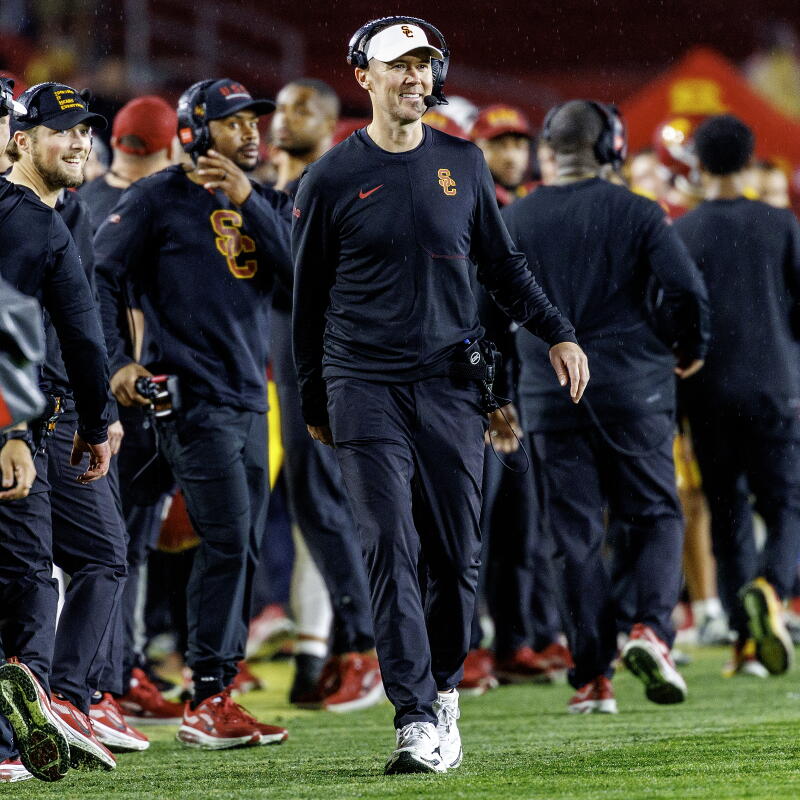
FIGHTING ON–USC Coach Lincoln Riley finally got his signature over No. 2 ranked Ohio State and moved back into the top 25 rankings at No. 17, now comes the hard part finishing what they started. (Jackson Burrell/Photo)
“I thought the backs ran harder,” he said, explaining that USC was more patient with its rushing attack and benefited from a healthier Waymond Jordan.
Then came the admission that deserves attention.
“We were just a tick off the other week, and then I didn’t do a good job staying with it. Both things were better tonight.”
That’s accountability. But it also raises a legitimate question about consistency.
If a more patient commitment to the running game helped USC against Ohio State, why wasn’t that same commitment maintained against Wisconsin?
One victory doesn’t establish that USC has arrived. It establishes what USC is capable of doing when its preparation, coaching decisions, and player execution finally come together.
The Trojans Didn’t Wait for Permission
USC needed just two plays and 39 seconds to make its intentions clear.
Quarterback Jayden Maiava found freshman receiver Trent Mosley behind the line of scrimmage. Mosley turned a short completion into a 69-yard touchdown, racing through Ohio State’s defense and giving USC a 7-0 lead before the Buckeyes had settled into the game.
The play wasn’t simply about speed. It was about execution away from the football.
Mosley credited Mark Bowman and another teammate for the blocking that opened the field in front of him.
“That thing opened up wide,” Mosley said.
He finished with five receptions for 101 yards, but the opening touchdown was only part of his contribution. His 44-yard punt return helped create the field position for Jordan’s nine-yard touchdown run later in the first quarter.
USC led 14-3 after one quarter and 20-9 at halftime.
King Miller rushed for 78 yards and a touchdown. Jordan added 48 yards and a score. Neither back produced overwhelming individual numbers, but both ran with determination, and the offensive line showed a willingness to compete against one of the nation’s better defensive fronts.
There was also a revealing moment when Jordan delivered a block to help spring Miller on a run.
Both backs weren’t merely sharing carries. They were sharing responsibility.
That is the kind of football Riley’s program needs to make routine rather than exceptional.
A Second Chance, and a Play Worth Remembering
Freshman tight end Mark Bowman had waited for an opportunity to return from injury.
Riley said Bowman had only recently been able to practice fully and entered the game on a limited snap count. USC couldn’t count on using him extensively.
It didn’t need to.
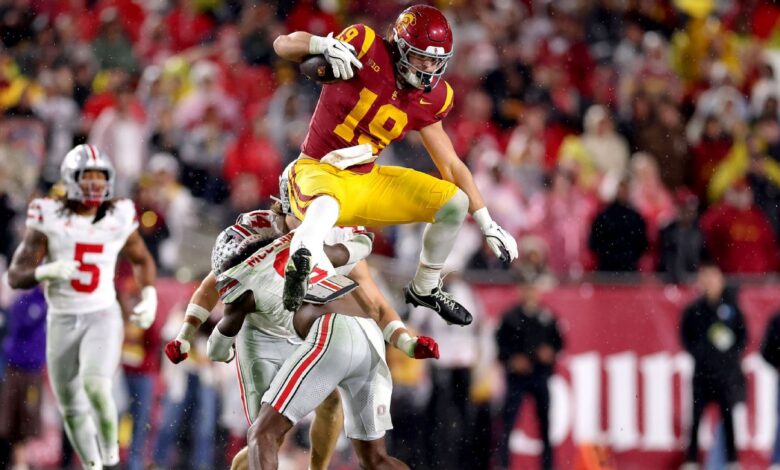
Bowman caught three passes for 79 yards, including a 70-yard reception that became one of the night’s defining offensive plays. He broke through the defense, hurdled a defender, and continued downfield before being brought down near the goal line.
Miller finished the possession with a one-yard touchdown run, extending USC’s lead to 27-9.
Bowman’s first words in his postgame media session weren’t about the hurdle or the yardage.
“I just love to give my glory to my Lord and Savior, Jesus Christ,” he said.
He spoke about being grateful simply to return to the field.
That perspective matters. For a player recovering from injury, the opportunity to contribute can mean more than the highlight itself.
When someone asked whether he thought he would score after breaking those tackles, Bowman smiled and offered a simple answer.
“You know, I thought so.”
The moment brought laughter. The play had already brought something more important: points and momentum when USC needed them.
Desman Stephens II Changed the Game
For all the attention USC’s offense deserved, linebacker Desman Stephens II supplied the defensive play that changed the second half.
Ohio State was moving the football, relying on a productive rushing attack led by Bo Jackson and Isaiah West. The Buckeyes had already demonstrated that they could advance the ball against USC.
Then Stephens delivered a physical hit on West, knocking the football loose. Floyd Boucard recovered the fumble.
The takeaway denied Ohio State another opportunity to cut into USC’s lead and set up the possession that ended with Miller’s touchdown.
It was more than one violent collision. Stephens played with awareness, range, and discipline, showing up against the run and in passing lanes.
His effort on a potential interception late in the fourth quarter was another example. The play was overturned because he failed to complete the catch inbounds, but the athleticism and anticipation were unmistakable.
Stephens was returning from a suspension following a targeting penalty against Oregon. Saturday offered an opportunity to make a different kind of statement.
He didn’t need to deliver a speech.
His football did the talking.
USC defensive tackle Alex VanSumeren said afterward that the defense’s trust had been developing long before this game.
“That trust has been built since January,” he said.
Perhaps. But trust must eventually translate into performance.
Against Ohio State, Gary Patterson’s defense showed meaningful progress. It didn’t shut down the Buckeyes between the 20-yard lines, and it certainly didn’t stop their running game altogether. But it consistently made Ohio State work for points.
The Buckeyes reached the end zone only once, with 2:12 remaining.
That was the difference between moving the football and winning the football game.
The Adults Let the Kids Down
Ohio State’s loss cannot be explained simply by the absence of injured starting quarterback Julian Sayin.
Freshman Luke Fahey was making his first career start on the road against a USC defense playing with confidence and physicality. He was going to make mistakes. He was going to miss throws. There were going to be moments when the speed of the game challenged his preparation and experience.
But Ryan Day and offensive coordinator Arthur Smith coached and called plays like they were the freshmen!
They were the adults in the room. And Saturday night, the adults let the kids down.
Fahey completed 21 of 38 passes for 260 yards and a touchdown. His receivers dropped catchable passes. Ohio State committed 11 penalties for 71 yards. The players have to accept responsibility for those mistakes.
But the coaching staff has to accept responsibility for the circumstances in which those mistakes occurred.
Arthur Smith came into this game with years of NFL experience, including time as an offensive coordinator and head coach. He has worked with professional quarterbacks, studied NFL defenses, and built offensive game plans against some of the best defensive minds in football.
Yet against USC, he struggled to consistently provide a freshman quarterback with the simplest thing an offensive coordinator can give him: manageable opportunities to succeed.
Where were the easy completions to establish rhythm? The quick throws, underneath crossing routes, tight end releases, and designed opportunities to put the football in the hands of Ohio State’s playmakers without asking Fahey to repeatedly challenge difficult coverage?
Why did the offense look so complicated for a quarterback who needed the game simplified?
This wasn’t a lack of talent!
Bo Jackson rushed for 121 yards. Isaiah West added 65. Ohio State finished with 204 rushing yards and 464 yards of total offense.
The Buckeyes held the football for 39 minutes and 28 seconds, ran 81 offensive plays, and produced 25 first downs.
And somehow, with all that possession, all that talent, and all that offensive experience on the sideline, Ohio State managed just one touchdown.
Arthur Smith’s play-calling was a complete joke Saturday night. He would have been better off going trick-or-treating with the rest of the kids in Los Angeles.
Four Connor Hawkins field goals kept the Buckeyes on the scoreboard before Fahey finally connected with Jeremiah Smith for a touchdown late in the fourth quarter.
That isn’t merely a failure to execute.
It’s a failure to turn available talent and offensive production into a coherent scoring strategy.
And that’s where the responsibility moves from the freshman quarterback to the men being paid to prepare him.
Day acknowledged the problem afterward, saying Ohio State hadn’t played well enough to support a freshman quarterback making his first road start.
He also explained why the Buckeyes were reluctant to increase their offensive tempo earlier.
“We didn’t want to panic,” Day said.
The intention may have been to protect Fahey from being overwhelmed.
But there’s a difference between protecting a young quarterback and protecting him so cautiously that the offense becomes predictable.
When Ohio State finally increased the pace and began giving Fahey more manageable completions, the offense found a rhythm. The Buckeyes moved the football and scored their only touchdown.
By then, the game was nearly over.
That’s what makes the coaching performance so putrid!
The adjustments that helped Fahey weren’t discovered after the game. They were available to the coaching staff throughout it.
Day and Smith had the experience to recognize what their quarterback needed. They had the personnel to create opportunities. They had a productive rushing attack to support him.
What they didn’t demonstrate consistently was the ability to put those pieces together before the outcome was largely decided.
And then there’s Jeremiah Smith.
Ohio State’s most dangerous receiver finished with 10 catches for 83 yards and a touchdown. He wasn’t completely removed from the offense, but his production raises another question: How does an experienced offensive staff fail to create more meaningful opportunities for a player of his ability when its freshman quarterback desperately needs help?
Smith shouldn’t have needed difficult downfield throws to influence the game. Screens, quick slants, crossing routes, and opportunities to work in space could have given Fahey accessible completions while forcing USC to account for Ohio State’s most explosive receiving threat.
Instead, too much of the offense placed the burden of creating something on the quarterback rather than the structure of the play.
That’s backwards.
A freshman quarterback shouldn’t have to rescue an experienced offensive coordinator from a game plan that isn’t working.
The coordinator is supposed to rescue the quarterback from situations his experience hasn’t prepared him to solve.
USC deserves credit. Gary Patterson’s defense made consequential plays, Desman Stephens II changed the game with his forced fumble, and the Trojans repeatedly denied Ohio State touchdowns despite surrendering substantial yardage.
But crediting USC doesn’t require pretending Ohio State’s coaching staff met the moment.
The Buckeyes had enough talent to move the football. They demonstrated that for nearly 40 minutes.
They didn’t have an offensive approach that consistently translated those possessions into touchdowns, and that responsibility belongs to Day and Smith.
The most inexperienced person directing Ohio State’s offense was supposed to be the freshman quarterback. Saturday night, too many of the decisions coming from the sideline made it difficult to tell.
The adults were supposed to make the game easier for the kids.
Instead, they made it harder.
Credit USC Without Excusing Ohio State
None of this means USC was handed a victory.
The Trojans had to block Ohio State’s defenders. They had to finish tackles, force turnovers, recover loose footballs, and capitalize on opportunities.
They did those things.
Maiava completed 15 of 22 passes for 222 yards and a touchdown. USC scored three touchdowns against an Ohio State defense that had rarely surrendered explosive plays. The Trojans also made the special teams contributions necessary to protect their advantage.
Matt Patricia’s defense had opportunities to stop Mosley and Bowman in space. USC’s players made those tackles difficult and, on the biggest plays, impossible.
That deserves recognition.
Riley identified the red zone as perhaps the biggest difference in the game.
“We played better in the situations,” he said.
He was right.
Ohio State produced 464 yards. USC produced 338.
Ohio State won time of possession. USC won the moments that turned possession into points.
There is no contradiction in recognizing both Ohio State’s coaching failures and USC’s earned victory.
The Buckeyes made mistakes. The Trojans punished them.
That’s what winning teams are supposed to do.
Now Comes the Harder Part
USC improved to 7-2 overall and 4-2 in Big Ten play. The victory over Ohio State gives Riley his biggest win with the Trojans and restores legitimate hope that this season can become something more.
But the question isn’t whether USC can beat a highly ranked opponent.
Saturday answered that.
The question is whether Riley can consistently produce the physicality, discipline, and situational execution that made the victory possible.
His team had already shown it could defeat Penn State. It followed that performance by scoring seven points against Wisconsin.
Now it has beaten Ohio State.
The next challenge is proving that the standard doesn’t depend on the opponent, the occasion, or the emotion surrounding the game.
Riley and his players deserve to enjoy this victory. They earned it.
But the responsibility of a serious program is to turn an exceptional performance into an expectation.
For one Halloween night, USC didn’t need to convince anybody what it could become. The Trojans showed them.
The challenge now is proving that Saturday wasn’t simply a costume they wore for one game.