USC’s Freshmen Didn’t Wait Their Turn
They Earned Their Opportunity
By Jason Burrell | South Bay Black Journal
LOS ANGELES — For everybody outside USC’s football building, Saturday afternoon felt like an introduction to Trent Mosley.
Inside the building, apparently, they seen this coming.
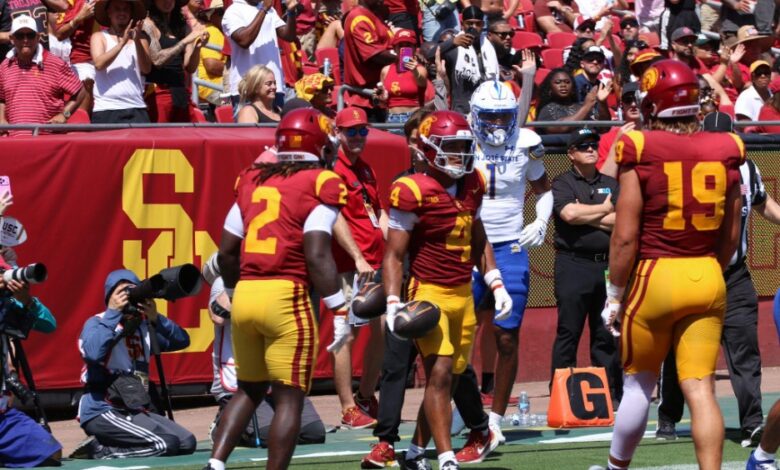
Mosley walked into the Los Angeles Memorial Coliseum for his first college football game and looked remarkably comfortable for somebody who had never played one before. The true freshman caught seven passes for 118 yards and a touchdown, returned two punts for another 56 yards and finished with 174 all-purpose yards as No. 14 USC opened its season with a 42-26 victory over San José State.
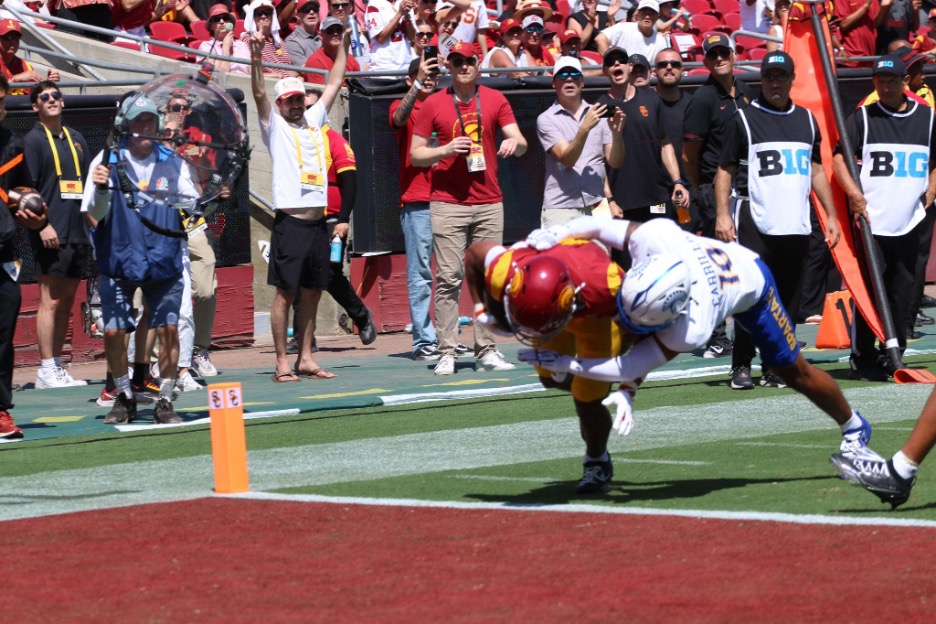
Trent Mosley ( Eric Lampkins II Photo)
Those are the numbers people will remember.
Lincoln Riley seemed more interested in everything that came before them.
“I don’t think anybody here is very surprised,” Riley said afterward.
That might have been the most revealing thing anyone said about USC’s freshmen all afternoon.
Everyone else spent the offseason looking at recruiting rankings, stars and projections, wondering what USC’s highly regarded freshman class might eventually become.
The Trojans were watching them practice.
They were watching who could handle mistakes, who could learn the offense, who could be trusted when the ball wasn’t coming his way and, eventually, who had earned the right to play when Saturdays became real.
Mosley wasn’t alone.
“You felt freshmen affect the game,” Riley said. “On defense, you felt it on offense, you felt it on special teams.”
And that’s what made USC’s opener interesting beyond the final score.
The Trojans have expectations much bigger than beating San José State in August. This is a program trying to get itself back into championship conversations.
Yet some of the players Riley is trusting to help USC get there were playing high school football a year ago.
Recruiting stars may have gotten them through the door.
Trust is getting them onto the field.
Mosley’s Day Was About More Than 118 Yards
Mosley’s statistics jump off the page.
Seven catches. 118 yards. A 14-yard touchdown from Jayden Maiava in the third quarter. A 41-yard punt return. And 174 all-purpose yards by the time his first afternoon of college football was finished.
But watching Mosley from the press box revealed something the box score couldn’t.
He blocked!
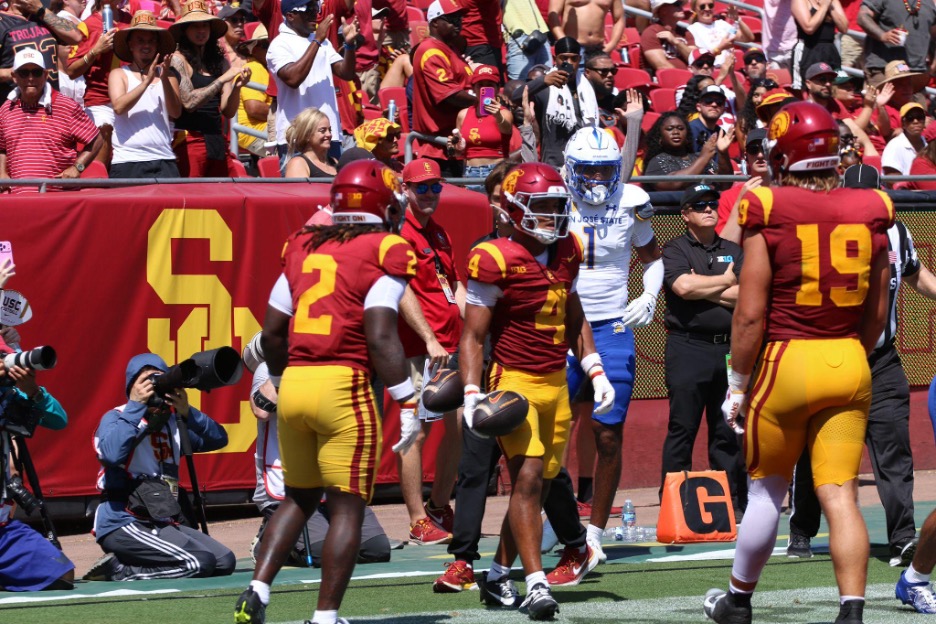
Trent Mosley ( Eric Lampkins II Photo)
There were plays when Mosley wasn’t getting the football and still found a way to affect the play. That’s easy to overlook when a freshman is piling up receiving yards, but it matters when trying to understand why coaches trust a young player.
Riley described Mosley as consistent and explosive. Just as importantly, he noticed that the freshman didn’t shrink from the moment.
“He didn’t play hesitant,” Riley said.
Maiava’s explanation was even simpler.
“He does it in practice.”
That sentence says a lot.
To everyone watching from the Coliseum stands Saturday, Mosley looked like a freshman having a breakout debut.
To his quarterback, it looked like practice.
Maiava said Mosley spent the offseason making plays on the football and building trust. Saturday was simply the first time everybody else got to see it.
The public met Trent Mosley against San José State.
Mosley Wasn’t the Only One
That’s where Saturday becomes bigger than one freshman having a great afternoon.
Kayden Dixon-Wyatt caught four passes for 36 yards, including a nine-yard touchdown late in the second quarter. Freshman tight end Mark Bowman caught three passes. Ethan “Boobie” Feaster recorded his first college reception. Shahn Alston carried seven times for 30 yards and scored on a one-yard run in the fourth quarter.
Then there was Jonas Williams.
By the time Williams entered at quarterback, USC had control of the game. But Riley didn’t simply send him onto the field to hand the ball off and run out the clock.
Williams got to play quarterback.
He completed five of seven passes for 55 yards and helped direct a 10-play, 75-yard touchdown drive.
That matters.
There is a difference between allowing freshmen to play because the score says you can and trusting freshmen to participate in building the lead in the first place.
Mosley and Dixon-Wyatt were doing the latter.
They were on the field with Maiava while USC was taking control of the game. Both of Maiava’s touchdown passes went to freshmen.
And the veteran quarterback was about as efficient as USC could have asked him to be.
Maiava completed 25 of 29 passes for 286 yards, two touchdowns and no interceptions. He also scored on the ground. USC finished with 505 yards of offense, including 164 rushing.
That’s an important part of this freshman story.
USC isn’t asking these kids to save the program.
Maiava is the veteran quarterback. The Trojans have experience along their offensive line and in their backfield. The freshmen are being brought into a structure with older players around them.
They’re being asked to help.
That’s a much healthier burden for a young player to carry.
For Three Quarters, USC Looked Like the Team It Wants to Become
The strange thing about USC’s 42-26 victory is that the final score doesn’t really tell the story of the first three quarters.
USC led 35-3.
The offense was efficient. The Trojans controlled the football. And for three quarters, San José State couldn’t get into the end zone.
One second-quarter possession stood out.
The Spartans put together their best sustained drive of the first half and eventually reached USC’s 7-yard line. On fourth-and-1, San José State needed one yard to keep the drive alive.
USC took it away.
The Trojans stuffed the run for a loss and sent the offense back onto the field.
When Riley was asked afterward what pleased him most about Gary Patterson’s defense, he went back to that moment.
“We spend a lot of time talking about red-zone defense,” Riley said.
“If you don’t allow touchdowns in the red zone, you got a chance to be great.”
San José State’s first two trips into USC’s red zone produced a turnover on downs and a field goal.
For a defense beginning its first season under Patterson, there was something meaningful about that.
USC bent.
Then, when the field got short and every yard became more valuable, it refused to break.
For three quarters, anyway.
Then USC Got a Reminder
The fourth quarter changed the feel of the afternoon.
San José State scored 23 points in the final period after USC began rotating heavily into its depth. Quarterback Luke Weaver threw two touchdown passes and ran for another.
A 35-3 game became 42-26.
Riley wasn’t interested in pretending those final 15 minutes didn’t happen simply because USC won comfortably.
“Fourth quarter, not up to our standards,” he said.
That’s where this game offered USC something it probably needed.
The first three quarters showed the Trojans what their talent can look like when everything is connected.
The fourth showed them what happens when the standard slips.
Riley said Patterson wasn’t happy with the finish. USC’s defensive leaders weren’t either. According to Riley, players addressed their teammates in the locker room about maintaining the same standard regardless of who is on the field.
That is part of developing young players, too.
Opportunity isn’t just getting onto the field.
It’s understanding what is expected once you get there.
If USC really intends to compete for championships, its standard can’t belong only to the starters. It has to reach the second team, the freshmen and the kid getting his first meaningful snaps when the Trojans are ahead by 32.
Eventually, those players won’t be backups anymore.
Talent Gets You Noticed. Trust Gets You on the Field.
There will be harder Saturdays than this one.
Much harder.
San José State won’t determine whether USC belongs in the College Football Playoff conversation, and beating the Spartans doesn’t mean every question surrounding the Trojans has suddenly been answered.
The fourth quarter made that clear enough.
But opening games aren’t always about answers.
Sometimes they’re about discovering what you have.
And USC may have discovered that some of its future is ready sooner than expected.
Mosley didn’t need a season standing on the sideline before USC trusted him with punts and meaningful offensive snaps. Dixon-Wyatt didn’t need to wait until garbage time before Maiava trusted him in the end zone. Other freshmen found their way onto the field because, as Riley explained afterward, they had already done something before anyone entered the Coliseum Saturday.
They earned it.
That’s the part recruiting rankings can’t measure.
Stars can tell us how fast a teenager runs, how many offers he received and what evaluators believe he might eventually become.
Football asks something more personal.
Can I trust you?
Can the quarterback trust you to be where you’re supposed to be?
Can your running back trust you to block when the ball isn’t coming your way?
Can your coach trust you with a punt hanging in the hot California sky?
Can your teammates trust you when one yard separates the defense from getting off the field?
USC handed some of its youngest players those responsibilities Saturday.
They didn’t look like kids waiting for their turn.
They looked like football players earning the next one.