USC young D leans on Riley
USC’s Young Defense Couldn’t Borrow Lincoln Riley’s Experience. It Had to Earn Its Own.
By Jason Burrell | South Bay Black Journal
LOS ANGELES — There are some things a coach can teach.
Where to line up. What coverage to play. How to attack a protection. What to do on third-and-14 with a quarterback capable of turning a broken play into 30 yards.
Then there are things players have to learn on their own.
How to respond when 59,136 people are watching and some of them are booing.
How to respond when you have spent an entire week talking about correcting mistakes, only to watch some of those same mistakes show up again.
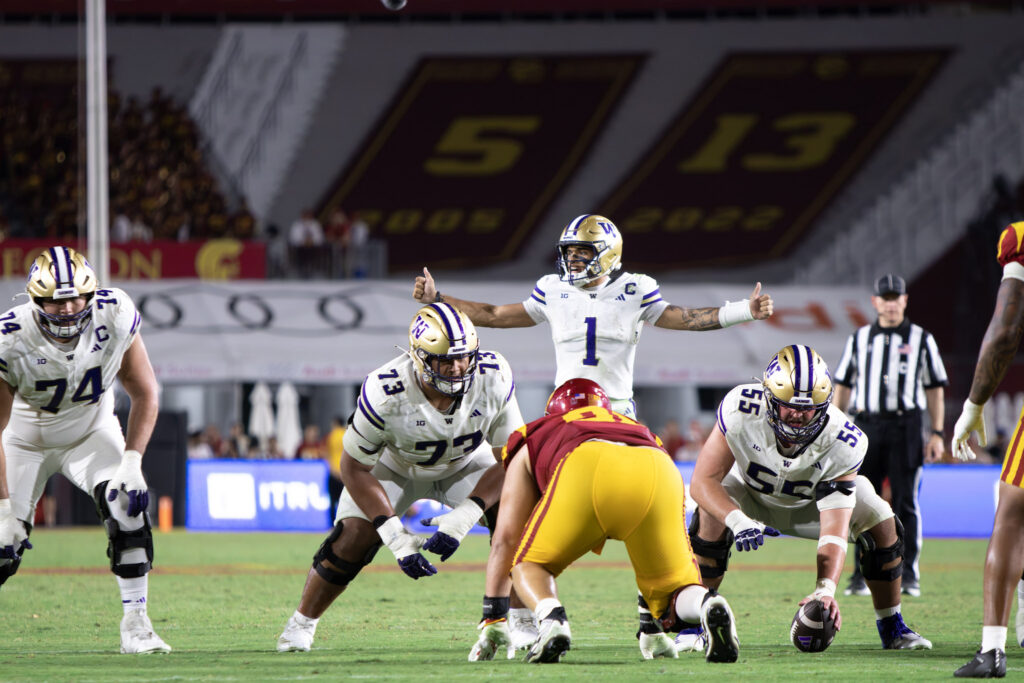
THUMBS UP WENT DOWN-– USC defense held on against unranked Washington in a Big 10 battle at the Coliseum, defeating the Huskies 25-21 on Oct. 2 (JACKSON BURRELL/PHOTO)
How to respond when you’re down 21-10 at home and the game is beginning to feel like it’s getting away from you.
Lincoln Riley has been doing this long enough to know what those moments feel like.
His players haven’t.
And maybe that was the most important thing in USC’s 25-21 victory over Washington Saturday night at the Coliseum.
The Trojans didn’t play particularly well for stretches. They committed nine penalties for 84 yards. Jayden Maiava finished with 245 passing yards and a touchdown, but never seemed to find a consistent rhythm. USC moved the football better than the scoreboard suggested, then repeatedly found ways to make life more difficult on itself.
Riley didn’t hide from it afterward.
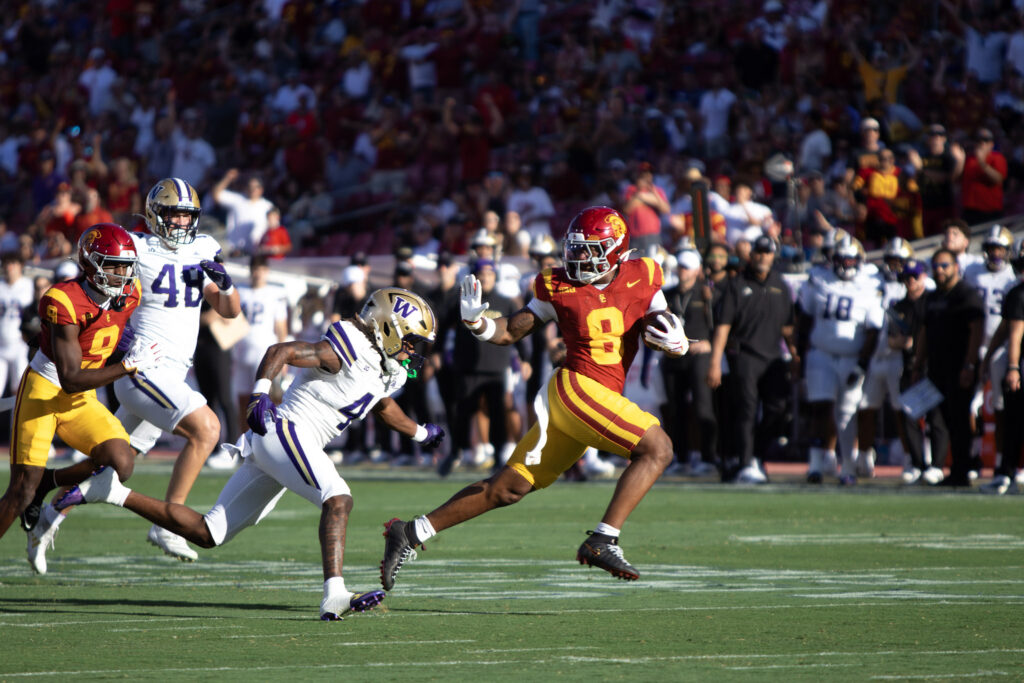
RUN AWAY KING--USC running back King Miller spurts past Washington defenders in Trojans hard fought 25-21 victory before nearly 60,000n at Coliseum on Oct. 2. (JACKSON BURRELL/PHOTO)
“It wasn’t a very clean performance,” he said. “Penalties were just massive in this game.”
Then he said something even more revealing.
For long stretches, Riley believed USC was outplaying Washington. But penalties and missed opportunities kept the Huskies in the game.
“We just kind of couldn’t get out of our own way a little bit,” Riley said. “And that’s going to be probably a defining thing for this team going forward.”
He’s right.
Because USC’s biggest opponent Saturday wasn’t always Washington.
Sometimes it was USC.
The Last 19 Yards
That became apparent almost immediately.
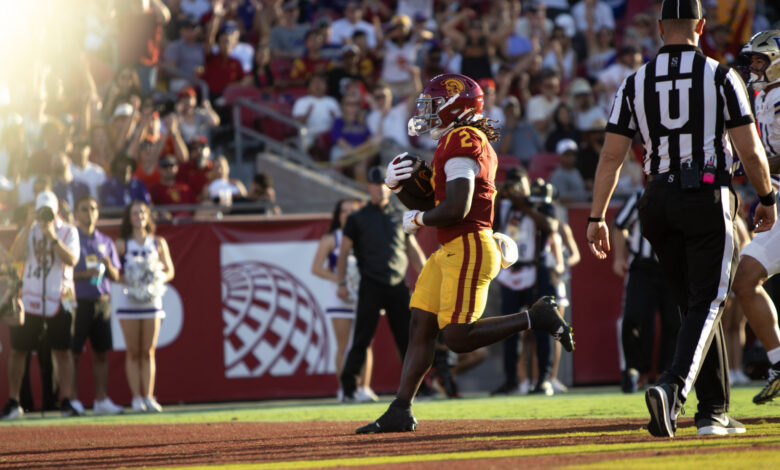
USC marched 75 yards on nine plays on its opening possession. King Miller ripped off a 35-yard run. The Trojans moved the football almost everywhere they wanted.
Then they reached the red zone.
Everything changed.
The field got smaller. The windows tightened. USC settled for a 26-yard field goal by Caden Chittenden.
There is something different about those last 19 yards of a football field.
Between the 20s, space can hide things. Speed can create answers. Scheme can manufacture openings, but near the goal line, eventually somebody has to move somebody.
Washington understood that.
Brian Bonner kept challenging USC’s middle. The Huskies mixed physical football with creativity, including Dezmen Roebuck’s five-yard touchdown pass to tight end Baron Naone.
USC answered with a touchdown of its own, but Washington came back again.
At halftime, the scoreboard said Washington 14, USC 10.
The statistics told a different story.
USC had outgained Washington 222-133. Washington hadn’t converted a third down.
Not one!
Yet USC was losing?
That’s when the boo birds began making themselves heard around the Coliseum.
And frankly, the frustration was understandable.
USC wasn’t being overwhelmed. It was underachieving!
Then Came the Test
Whatever USC discussed at halftime didn’t fix things immediately.
The Trojans ended the first half with an unsportsmanlike conduct penalty and opened the second half with another.
Then Washington attacked a wound USC thought it had spent the week treating.
The tight end.
A week earlier, after Oregon tight end Jamari Johnson repeatedly hurt USC’s defense, safety Christian Pierce described much of the problem as miscommunication.
Seven days later, Washington came out of halftime with a flea-flicker and went right back at USC’s defense with its tight ends.
Two plays.
Sixty yards.
Forty-eight seconds.
Touchdown!
Washington 21, USC 10.
At that point, “miscommunication” couldn’t remain the answer forever.
When the same problem follows you from one Saturday into the next, the question eventually changes.
It stops being, What went wrong?
It becomes, Why hasn’t it been fixed?
That’s not being unfair to a young defense.
That’s the standard that comes with playing football at USC.
But something happened after Washington went up 11.
USC stopped explaining.
And started answering.
Growing Up Doesn’t Always Look Pretty
The offense responded first.
USC put together a 13-play, 75-yard drive. This time, when the field compressed, the Trojans became more physical.
Waymond Jordan went inside.
King Miller went inside.
On third-and-1, USC put the ball back into Jordan’s hands.
Then Maiava found Tanook Hines in the corner of the end zone, and Hines went up like a grown man and took the football away from the defender, but USC still trailed 21-16 after the failed two-point conversion.
Then the young defense had its moment.
On third-and-8, Elijah Newby got to Washington quarterback Demond Williams Jr. and forced the fumble.
Jahkeem Stewart picked it up, and Forty-eight yards later, the freshman defensive lineman was in the end zone.
USC had the lead, and the Coliseum sounded very different.
But here’s where we have to be careful; one spectacular play doesn’t mean a defense has grown up. Anybody can make one play, but what happened afterward mattered more.
Washington got the football back.
USC stopped it.
Washington got another opportunity.
USC stopped it again!
Then, on third-and-14 in the fourth quarter, Alex Graham got to Williams for another sack, and by the end of the night, Washington had converted one of 12 third downs.
USC had five sacks. That’s not perfection. That’s response.
And there’s a difference.
What Riley Knows That His Players Don’t, Yet.
This is where I keep coming back to Riley.
It takes a strange kind of patience to coach a young football team when you’ve already experienced many of what they’re facing for the first time.
You know what adversity feels like.
You know a bad quarter doesn’t have to become a bad game.
You know one loss doesn’t have to become two.
You know what championship football requires.
But you can’t simply hand that understanding to somebody.
You can coach it, warn them, and show them on film. Coach Riley can even tell them when it’s coming, but eventually, they have to live it.
Riley came close to saying exactly that afterward.
He talked about how much he believes in this team and then explained part of his motivation for coaching it.
“I want these guys to feel what I’ve been able to feel,” Riley said, reflecting on the memorable moments he’s experienced throughout his career. “I want these guys to be able to experience some of the things I’ve been lucky enough to do.”
That’s bigger than Saturday night’s score.
Because Riley’s challenge may not be simply teaching these players how to win.
It’s having enough patience to allow them to learn how to win.
There is a difference.
A coach can give you the answer.
Experience teaches you why the answer matters.
The Tip of the Spear
There were coaching adjustments, too.
Gary Patterson moved upstairs to the coaches’ box after he and Riley discussed the change earlier in the week.
Riley described coaching as arranging pieces on a chessboard, putting people in positions that let them perform at their best.
“I thought Gary called a really good game,” Riley said. “And the players responded.”
The defensive line certainly did.
Jahkeem Stewart said the defensive line is the “tip of the spear” and said the emphasis was on staying connected rather than watching the scoreboard.
Riley later used the same phrase.
“Our D-line is the tip of the spear,” he said, adding that USC has reached the point where it should expect a big-time performance from that group every week.
That’s a standard.
Now USC has to prove Saturday wasn’t an exception.
Don’t Confuse Growth With Arrival
That’s where some restraint is necessary. USC won, but that doesn’t mean USC has arrived. Those are two very different statements. The penalties were real. The miscommunication was real. The offensive inconsistency was real. The boos were real. So was falling behind 21-10, and if USC plays that way against better teams, eventually toughness won’t be enough to rescue it. Riley knows that, but he also recognized something else Saturday.
“To overcome all that and still win shows me some of the guts and toughness and culture in this room,” he said. “We could have folded.”
Thank God they didn’t.
Maybe that’s the part worth remembering.
Because young teams don’t become veteran teams because another birthday passes.
They become veteran teams by accumulating moments.
The 21-10 deficit when everybody discovers whether all that talk about being connected actually means something.
Even the boos.
Especially the boos.
Riley called it a “gutsy” win and suggested that surviving a game without your best performance can sometimes give a team something a blowout can’t.
I think he’s right.
A blowout can confirm what you already believe about yourself.
Adversity introduces you to the parts of yourself you haven’t met yet.
USC met some of those parts Saturday night; not all of them were pretty.
But when Washington went ahead 21-10 and the Coliseum grew restless, USC’s young defense was finally placed in a situation no meeting room, practice period, or film session could completely reproduce.
They had to experience it. They had to respond to it.
And then they had to finish it. A week ago against Oregon, USC learned that competing can get you to the moment.
Saturday night, the Trojans learned something else.
You don’t become experienced by being told what the moment requires.
You become experienced by executing the moment yourself.