Washington: At CBC Week, California Leaders Center Economic Power and Investment in Black Institutions
Regina Wilson | California Black Media
“We have to lean into talking about money and economics, economic development.”
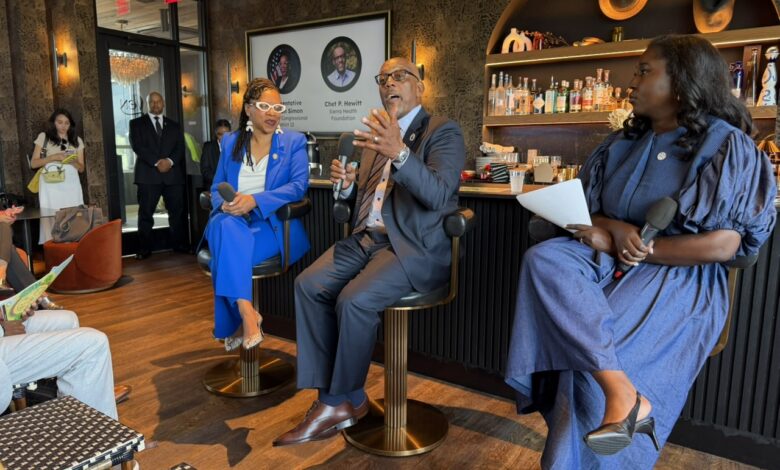
U.S. Rep. Sydney Kamlager-Dove (D-CA-37) delivered that message as California leaders gathered in Washington, D.C., during Congressional Black Caucus (CBC) Week for a conversation about economic power, strengthening Black institutions and investing in the people and organizations that serve Black communities.
“We cannot be ashamed,” Kamlager-Dove said. “We’ve been ashamed to want to talk about money. We have been shamed to not want to say it is important.”
For families trying to pay for childcare, care for aging relatives, send children to college, cover rent or build savings, she said economic stability cannot be separated from conversations about Black progress.
The Sept. 17 gathering, “Rooted and Ready: Building the Coalition to Protect Black Futures,” was presented by the Aya Education Coalition and Sierra Health Foundation during CBC week.
Sierra Health Foundation President and CEO Chet P. Hewitt said strengthening Black communities requires investing in institutions that preserve Black history, culture and independent voices, including Black-owned media, bookstores and museums.
“The pathway to prosperity for Black people is not a service. It’s an opportunity,” Hewitt said.
He pointed to efforts supporting more than 100 Black bookstores as spaces for Black intellectuals, artists and creators, along with investments in Black newspapers and smaller Black museums that serve as repositories of history. His message was that Black communities need institutions with the resources to survive, grow and continue telling their own stories.
U.S. Rep. Lateefah Simon (D-CA-12) brought another perspective, drawing on her experience in philanthropy and organizing before entering Congress. Simon represents the East Bay district previously represented by Barbara Lee, who is now Mayor of Oakland.
Simon spoke about her experience serving in the CBC, acknowledging that its members do not always agree on policy while emphasizing the importance of Black leaders working collectively around shared concerns affecting Black communities.
She pointed to the California Black Freedom Fund as an example of building an institution intended to endure. Simon recalled working with Hewitt and other California philanthropic leaders in 2020, following the murder of George Floyd, when corporations and foundations announced major racial equity commitments.
Simon said they understood that the surge of attention and funding might not last. That concern helped drive the creation of the California Black Freedom Fund, which was designed to provide sustained resources to Black-led and Black-serving organizations beyond the immediate moment. Simon was among the fund’s initial founders.
The conversation about strengthening Black institutions extended to California’s Black educator pipeline.
According to materials distributed by the Aya Education Coalition, approximately 10,400 Black teachers worked in California public schools during the 2024-25 school year, representing 3.5% of the state’s teacher population.
Dr. Shawn Ginwright said the challenge is not simply recruiting Black educators.
“We’re not recruiting enough. We’re not keeping enough either,” he said.
Speakers discussed the roles Black educators often play as mentors and trusted adults, as well as burnout and mental health challenges that can push educators out of the profession.
Dr. Colette Harris-Mathews, an Area 5 trustee for the Los Rios Community College District who attended the gathering, said the connection between economics, education and mental health stood out to her.
“People are traumatized by what they’ve experienced in education, what they’ve experienced post-COVID, what they’re experiencing in terms of racism and simply being under attack in terms of finances, too,” Harris-Mathews said.
The panel brought together Kamlager-Dove; Simon; Hewitt; Ginwright of the Harvard Graduate School of Education; Randy Seriguchi Jr. of Akoben Organizing; and Jalisa Evans of the Aya Education Coalition.
The Aya Education Coalition is organizing around a 2030 goal to strengthen California’s Black teacher pipeline and advance policies addressing recruitment, preparation, retention and support.
For the California leaders gathered in Washington, the message extended beyond education and basic economics. Speakers urged attendees to identify Black institutions at risk of disappearing and consider how their resources, relationships and economic power could help sustain them.