Jones-Sawyer Expects Slavery Apology Plaque to Go Up After Capitol Construction
Antonio Ray Harvey | California Black Media
Once the State Capitol East Annex Project is completed, plans will move forward to install a plaque displaying California’s formal apology for its role in supporting chattel slavery and its legacy of systemic racism, according to former Assemblymember Reggie Jones-Sawyer.
On April 20, Jones-Sawyer, a former member of the California Legislative Black Caucus (CLBC) who represented parts of Los Angeles in the State Assembly from 2012 to 2024, visited the State Capitol. During that trip, he told California Black Media that the plaque would not be installed until after construction is finalized, and a location within the facility is authorized.
“We’re all talking about where the ideal spot is because there are rules and regulations for where you can put things that are state-mandated,” Jones-Sawyer said. “Once we figure out all of our different places where we don’t go up against the rules, whether it’s construction, then we’ll put it in a place where any young person that comes into the building, it is something they can see, read, and learn from.”
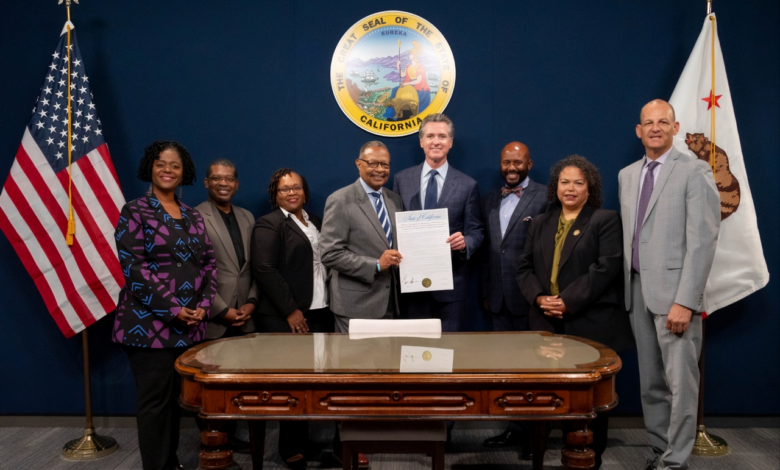
The Official State Apology for Slavery was established by Assembly Bill (AB) 3089, authored by Jones-Sawyer, and signed into law by Gov. Gavin Newsom on Sept. 26, 2024. It acknowledges that California enforced fugitive slave laws and tolerated slavery, despite entering the Union as a “free state.”
AB 3089 passed the Legislature with bipartisan and unanimous support. The legislation includes critical measures that address a wide range of issues affecting Black Californians, from criminal justice reforms to civil rights and education.
“The State of California accepts responsibility for the role we played in promoting, facilitating, and permitting the institution of slavery, as well as its enduring legacy of persistent racial disparities,” Newsom stated. “Building on decades of work, California is now taking another important step forward in recognizing the grave injustices of the past – and making amends for the harms caused.”
AB 3089 was a key component of the 2024 Reparations Priority Bill Package introduced by CLBC. Newsom signed a number of bills included in the 14-bill package to address the legacy of racial discrimination in the state.
The formal apology was a key recommendation in the 2023 report created by the California Reparations Task Force, which spent two years studying the impacts of slavery and atrocities committed against Black Californians.
While the Task Force recommended direct cash payments, AB 3089 is a non-monetary, symbolic action focused on official acknowledgment. Jones-Sawyer emphasized that AB 3089 is a necessary foundation for healing and future action. The law declares a commitment to “restore and repair affected peoples.”
On Jan. 10, 2025, the California Department of General Services (DGS) submitted to the Legislature a request of $500,000 “for the purposes of memorializing a plaque” in the State Capitol building. The project would occur over the course of at least two fiscal cycles.
“Whatever configuration, should it be a bronze plaque, encased with papers, or written, we want it to give the kind of gravitas that when you’re looking at it, you’re proud to see it,” Jones-Sawyer said.
AB 3089 is a landmark California law. Jones-Sawyer said learning about the legislation and broader reparations effort is essential for Black Californians and residents of the state because it represents the first formal state-level acknowledgment of historical injustices.
“The plaque is about learning. Learning about our history, but most importantly, why we should not repeat that part of history ever again,” Jones-Sawyer told CBM. “We want it to be a learning opportunity for everyone, no matter what color, race, or gender.”
Jones-Sawyer officially left the California State Assembly on Dec. 2, 2024, after reaching his term limit. While he has been active in public life since leaving office, he is currently pursuing a doctorate in policy, planning, and development at the University of Southern California (USC) Price School of Public Policy.
“Yes, I have been busy since leaving the Legislature,” Jones-Sawyer said. “It’s been great. I feel good.”
Jones-Sawyer’s visit to the State Capitol happened a few weeks after Assemblymember James Ramos (D-Highland) introduced a bill, AB 2115 – California State Legislature’s Formal Apology to California Native Americans Act – in February 2026. The legislation proposes that the Legislature and the courts formally apologize to California’s Native Americans for past atrocities.
The “demand,” Ramos stated, follows a previous executive apology from Gov. Gavin Newsom in 2019, which Ramos noted had not yet been formally joined by the other branches of state government.
The apology is necessary to address California’s historical role in inhumanity committed against Native Americans, including state-sanctioned wars against tribes between 1851 and 1859 and the payment of bounties for the heads of Native Americans, an action Ramos said was an “extermination of the Indian race.”
“AB 2115 would provide that the State of California recognizes and accepts responsibility for all of the harms and atrocities committed by its public officials, those who promoted, permitted, facilitated, and enforced policies of violence against California’s First People,” Ramos said.