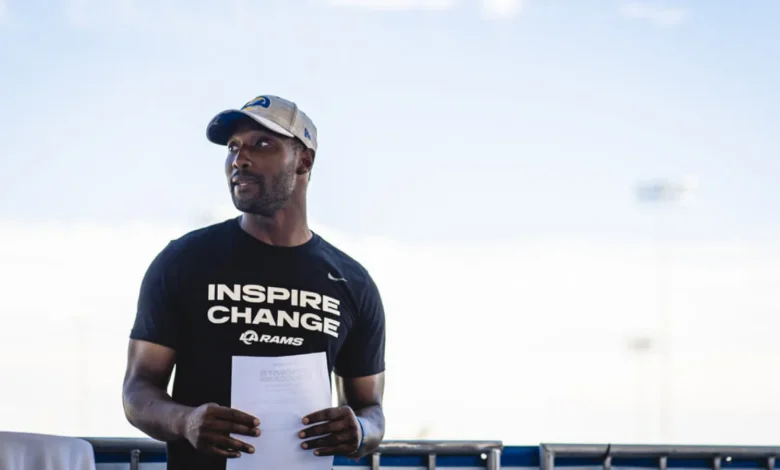
Johnathan Franklin Once Measured Success in Yards. Now He Measures It in Access.
By Jason Burrell | South Bay Black Journal
LOS ANGELES — There was a time when Johnathan Franklin could measure almost everything that mattered to him.
Yards gained. Touchdowns scored. Games won. Games lost.
Football provided a scoreboard, a stat sheet and, eventually, an NFL uniform.
More than a decade after his playing career ended, Franklin believes he is giving more to football now than he ever could have by carrying it.
I asked him whether he considers himself more valuable to the game today than when he played it, and he did not hesitate.
“I would say yes, 1000%,” Franklin said. “I believe that I have a bigger impact now than I would have playing the game.”
The answer says something about Franklin’s evolution, but perhaps even more about the way he now defines success.
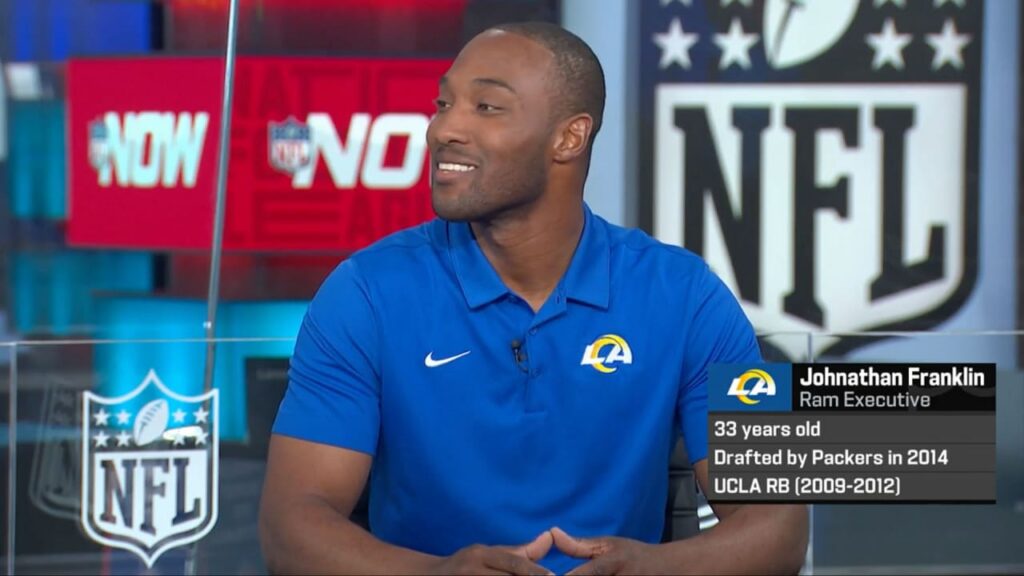
As Senior Director of Social Justice and Football Development for the Los Angeles Rams, Franklin’s work cannot be measured in rushing yards. There is no box score for a young man who receives a helmet his school could not afford, a teenager who discovers a career pathway he did not know existed, or a community that begins to trust an NFL franchise enough to call when something goes wrong.
Franklin measures different things now.
Access.
Opportunity.
Sustainability.
Trust.
And whether the door remains open after the Rams walk away.
“When you think about social justice, it’s all about access and opportunity,” Franklin said. “There are many barriers in front of many Angelenos that need the access to become the best version of themselves.”
That philosophy has become central to how Franklin approaches his job.
If someone followed him around Los Angeles for a month, he said, they would see less prescribing and more listening.
Before programs are created, checks are written, or equipment is delivered, Franklin wants to understand what people actually need.
It is an approach he describes simply as: listen, learn, and respond.
That philosophy was tested almost immediately when the Rams returned to Los Angeles in 2016.
One of the early questions facing the organization, Franklin said, was whether community programs from St. Louis should be transported to Los Angeles along with the football team.
Franklin and others pushed back and said emphatically, “No,”.
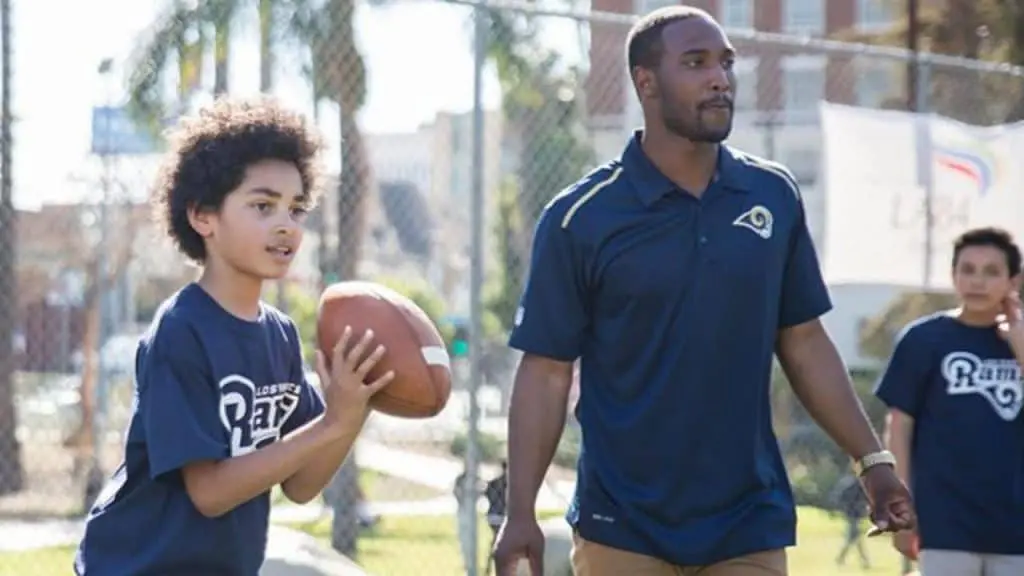
Listen, Learn, and Respond
Los Angeles was a different market with different problems, barriers and communities. What worked somewhere else could not automatically be assumed to work here.
“We’ve always allowed the community to lead our strategies,” Franklin said. “We need to collect information from the community to strategically show up in an authentic way, but also we want to move the needle.”
That has meant meetings with school districts, nonprofit organizations and community leaders. It has meant studying trends. It has meant what Franklin calls listening tours, sitting across from people already doing the work rather than assuming an NFL organization knows more because it has more resources.
Another listening tour is already taking shape.
Franklin said his attention over the next three to six months will increasingly turn toward workforce development, particularly the gaps facing people transitioning from high school and college into employment.
The problem, he said, is not always a lack of ambition.
At times, the pathway is obscured by structural barriers and a lack of clearly defined points of access.
“Many times the pipeline, the awareness, the access points aren’t always clear, and they don’t exist,” Franklin said.
Rather than create a program first and search for people to fit inside it, Franklin wants to begin by sitting down with leaders across Los Angeles and asking what is missing.
That willingness to listen has also changed the Rams’ relationship with the city.
Franklin remembers an organization returning to Los Angeles that was not necessarily invited into every important community conversation.
Ten years later, he sees something different.
During moments of crisis, he said, community organizations now contact the Rams and ask how the team can help, what perspective it can provide, or whether it can become part of the response.
That may be one of the quieter measures of the Rams’ work.
Trust.
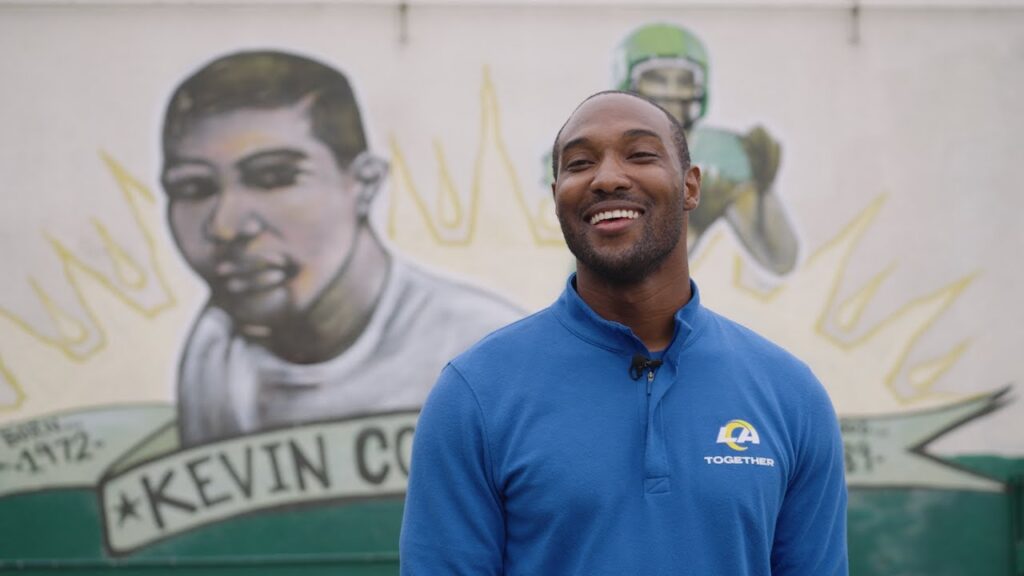
DORSEY DON AT HEART- Johnathan Franklin, stands in front mural on the Dorsey campus that commemorates friend high school All-American wide receiver Kevin Copeland who played for Dorsey 1987-1989. Copeland died of a heart attack on the field during a Dorsey game on October 7, 1989. (Jackson Burrell/Photo)
“When we first got here, we weren’t necessarily included in those discussions,” Franklin said. “We wanted to be a community partner, a trusted partner.”
Now, he said, being included in those conversations is something the organization does not take for granted.
That same philosophy shaped one of the Rams’ largest football development investments of 2026.
Before distributing more than $1 million in equipment and grants to youth and high school football programs, Franklin said the organization surveyed nearly 200 high schools to understand what had changed.
Football had changed.
Learn, and Respond
The country was beyond the pandemic. Girls flag football was accelerating. Participation patterns were different. Equipment costs had climbed.
The Rams did not want to assume the problems of 2018 were still the problems of 2026.
The survey showed equipment access was one of the leading reasons participation was declining and, in some places, why football programs were struggling to survive.
That answer led to something tangible.
- Some schools received helmets they could not otherwise afford.
- Others received cameras that allowed players and coaches to study film for the first time.
- One program received a five-man blocking sled after going more than three decades without one.
For Franklin, those are not simply donations.
They are access points.
“How can we level the playing field?” he said.
Responding
The applications required schools to explain why they needed the equipment, how many athletes would be affected, andwhether the resource could create lasting value.
That last part matters to Franklin.
Sustainability, in his view, means a program should still matter years after the ceremonial photographs have been taken.
“We want to make sure that what we provide, what we donate, the experience, the opportunity, doesn’t cease to exist after a year or two,” Franklin said.
Then he offered perhaps the clearest definition of sustainable community work.
“Regardless if the Rams are involved or not, it remains open,” he said. “And everyone is still able to rise.”
That philosophy can also be seen in Inglewood.
The Rams have helped expand football opportunities throughout the city, including a new flag football league involving all eight elementary and middle schools within Inglewood Unified.
But Franklin does not view those programs simply as an attempt to produce future NFL players.
He sees football as a vehicle for creating opportunities beyond the field, bringing young people together, building confidence and discipline, connecting them with mentors and resources, and helping communities address barriers that extend far beyond the game itself.
Students from different neighborhoods and schools can meet one another. Young people separated by racial divisions, neighborhood boundaries, or neighborhood influences can suddenly share the same field.
“What the game of football does, it removes those barriers,” Franklin said. “It allows us to be united.”
From a football perspective, he said, the broader goal is to restore pride throughout the district while building a pipeline that connects girls flag football, youth flag football and the high school game.
In that sense, the football itself becomes almost secondary.
The Rams are providing the game.
Franklin is interested in what the game can provide back.
That understanding did not come easily.
Franklin’s own playing career ended abruptly after a neck injury during his rookie season with the Green Bay Packers. For a young man whose identity, ambitions and understanding of success had been built largely through football, losing the game forced him to confront what remained when the uniform disappeared.
He eventually discovered that the answer would require more than simply finding another job.
It required redefining himself.
Franklin said faith became central to that process.
“I really had to learn how to process,” he said. “For so long, I didn’t process anything.”
He had to learn how to identify what he was feeling and then become vulnerable enough to acknowledge it.
There was guilt.
There was shame.
There was disappointment.
There was fear of judgment and fear of failure.
And there was the uncomfortable reality that life had moved somewhere Franklin never planned to go.
“I think truly until I started to build my relationship with God, I had to be vulnerable in my prayers,” Franklin said. “I had to surrender to a new path and new plan and accept the reality of my life.”
That surrender, he said, was not immediate.
Peace took years.
Part of the difficulty was separating his own life from the measurements society often uses to define whether someone is successful.
Professional accomplishments.
Income.
Success by a certain Age.
Status.
Milestones reached on the world’s timetable.
Franklin had lived inside one of the clearest versions of that formula.
At Dorsey High School, he said, success often appeared to have only a few recognizable destinations.
“You got to be an entertainer, you got to be a ball player,” Franklin said. “You got to make X amount of dollars. You got to do this by that.”
He sees that differently now.
“It’s just such a deception,” Franklin said.
His definition of success today includes things that never appeared on a scouting report.
Character.
Joy.
Peace.
The independence to think for himself.
The willingness to challenge the status quo.
And the faith to believe that a season of life can still have purpose even when it looks nothing like the one he would have chosen.
“I had to separate the expectations of the world and surrender to the will of God,” Franklin said. “Once I figured that out and connected with that reality, everything changed for me.”
Everything did not become easy.
That distinction matters.
Franklin does not tell his story as though faith eliminated every old question.
Sometimes he still misses playing.
Sometimes the “what if” returns.
Sometimes he imagines what might have been different had his NFL career continued.
The difference is that those thoughts no longer have to control where he goes next.
“The process isn’t ended,” Franklin said. “I think it will always continue because I will always enjoy and appreciate or miss a part of the game.”
His faith, he said, has taught him to remain surrendered even when those feelings return.
“I just have to trust that God knows best,” Franklin said.
Perhaps that is why Franklin now sees football differently.
When he played, the game itself could become the destination.
Today, he sees it more as a vehicle.
“There was a time of the season when I was playing the game, and I’m grateful for the time that I played because it definitely opened doors for me,” Franklin said. “There’s so many skills that I’ve gained and learned from playing the game of football that just prepared me to be where I’m at now.”
But distance changed his perspective.
“So often when I was playing the game, I was just so focused on the X’s and the O’s and wins and losses,”Franklin said. “But right now we’re trying to help people in the community win in life.”
Then he described the mission another way.
“The vision is not helping young individuals go pro in sports,” Franklin said. “But how can we help them grow pro in life?”
That ultimately explains why Franklin believes he is more valuable to football today.
His platform as an active NFL player might have been larger.
His understanding of what to do with that platform, he believes, is larger now.
Responding Differently
What changed was not his appreciation for football.
It was his understanding of its reach.
“I didn’t understand the bigger picture beyond the game of football,” Franklin said.
He does now!
And perhaps the most revealing evidence is that the former running back no longer talks primarily about where football can take a child.
He talks about what football can leave inside one.
Relationships.
Discipline.
Confidence.
Opportunity.
Education.
Community.
A pathway.
A belief that where someone begins does not have to determine where that person finishes.
Franklin has said he wants to see a Los Angeles where ZIP codes no longer dictate whether children have access to strong schools, mentorship, safe fields, healthy food, or the resources necessary to pursue opportunity. The ambition is much larger than anything one football organization can accomplish alone.
Franklin acknowledges that.
“It takes all of us,” he said.
There are still communities dealing with food insecurity. There are still neighborhoods where healthy grocery options are limited. There are still schools without the resources available somewhere only a few miles away.
Franklin’s job is not to pretend football can solve all of that.
His job, as he now understands it, is to determine where football can help open a door and then work to keep that door from closing.
Once, Johnathan Franklin’s value to football could be counted every time he crossed another yard line.
Today, the measurement is harder.
There is no official statistic for a child who gets to play because a helmet finally became available. No scoreboard records a teenager finding a mentor, a school rediscovering pride in its Community, or a young person learning there are professions beyond the few examples he sees in his neighborhood football program.
Franklin may never be able to calculate all of it.
But he knows which version of himself he believes has more to give.
“I feel like I’m able to give the game more than I would have given when I was playing,” Franklin said.
The running back once tried to move the chains.
Now he is trying to make sure the pathway stays open.