Senate Advances Weber Pierson’s Bill to Reform Gang Databases
Antonio Ray Harvey | California Black Media
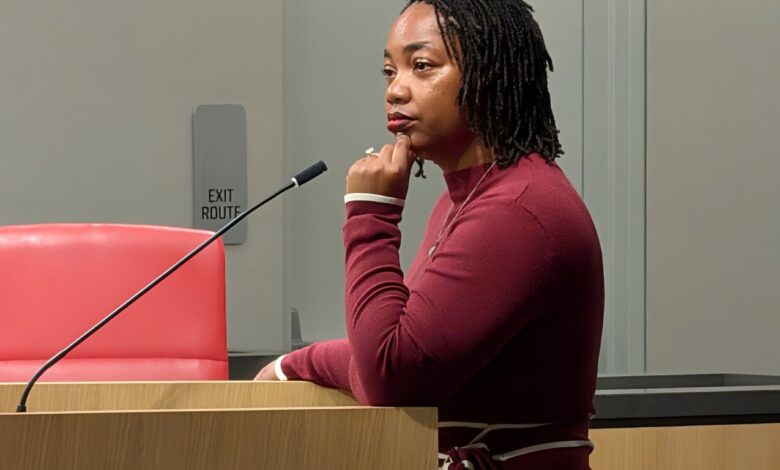
A bill authored by Sen. Akilah Weber Pierson (D-San Diego) aimed at reforming California’s gang databases — primarily the CalGang system — has advanced out of the Senate Public Safety Committee with a 5-1 vote.
Senate Bill (SB) 1210, introduced by the chair of the California Legislative Black Caucus (CLBC), seeks to address systemic inaccuracies, racial bias, and a lack of transparency that, according to the author, jeopardize the civil liberties of thousands of Californians — particularly Black and Latino individuals.
The measure now heads to the Senate Appropriations Committee for consideration.
“SB 1210 amends the Penal Code to make all gang databases, regardless of whether they are shared or not, subject to the Legislature’s previous and active reforms, including the Department of Justice’s oversight and regulations,” Weber Pierson said.
A key provision of the bill removes the restrictive term “shared gang database,” ensuring that state regulations apply to all gang databases, including those not accessed by external agencies. The legislation would require full compliance with Department of Justice regulations by Jan. 1, 2027.
The bill builds on findings from a 2016 state audit, requested by then-Assemblymember and current Secretary of State Shirley Weber, which identified widespread inaccuracies and weak oversight in shared gang databases.
Audits of the CalGang system revealed that law enforcement agencies relied on unreliable data, failed to purge records after five years, and included individuals without sufficient evidence. The database even listed toddlers “as young as three years old,” Weber Pierson said.
Following reforms that mandated audits for shared databases, some agencies shifted to internal systems not subject to the same level of oversight. Weber Pierson said SB 1210 is designed to close those loopholes by requiring all databases to meet the standards established under AB 90, the Fair and Accurate Gang Database Act of 2017.
“Being wrongfully placed in a gang database can have serious life-altering consequences, which is why the audit became an issue in the first place,” Weber Pierson said. “Including police scrutiny, higher bail, harsher sentencing through gang enhancement, barriers to employment, and now the risk of deportation.”
According to the California Department of Justice’s 9th Annual Report, the CalGang database contained 9,948 records as of Sept. 30, 2025. That figure represents a significant decline from earlier years, when the database held more than 100,000 records. Between 2017 and 2022, CalGang identified disparities in 103,840 entries.
The database is 94% male and disproportionately composed of Latinos (66%) and Black individuals (23%).
“Unfortunately, we are now seeing many law enforcement agencies that have chosen to disregard the legislature’s reforms by ending their relationships with the use of CalGang,” Weber Pierson said. “The number of law enforcement agencies entering records into CalGang has dropped from 214 to just 19. There is no evidence that these agencies stopped gang intelligence altogether.”
Opponents of the bill, including the California Police Chiefs Association (CPCA), argue that the measure could hinder law enforcement efforts.
Jonathan Feldman, a legislative advocate for CPCA, told the Senate Public Safety Committee that gang databases provide officers with immediate access to critical information, including photographs, tattoos, vehicle descriptions, and known associates. He said the tools are essential for tracing suspects, identifying victims, and supporting criminal investigations.
“I understand the shift to the local databases, not as an attempt to circumvent the oversight, but in terms of doing active investigations and needing to record that information on a daily basis,” Feldman said. “There is a need to develop those leads, collect that information without going into a formal database system.”
Feldman added, “I do think it’s difficult to take those AB 90 CalGang standards and apply them to all gang databases. A lot of these are informal, in process, and developing investigations.”
Supporters of the bill argue that disparities in the database reflect broader systemic issues. According to the Department of Justice, Black individuals are disproportionately represented due to factors such as concentrated policing in minority communities, subjective inclusion criteria, and data inaccuracies.
Weber Pierson also shared a personal account during the hearing, noting that her brother, who is 6 feet and 5 inches tall, was nearly added to the gang database in San Diego based solely on his race and physical appearance.
“He has never been affiliated with a gang in his life,” Weber Pierson said.
Sean Garcia-Leys, executive director of the Peace and Justice Law Center in Santa Ana, testified in support of the bill, noting that compliance with oversight requirements is feasible.
“Many others have opted out to avoid oversight,” Garcia-Leys said. “SB 1210 addresses this gap. It does not expand the law or rebalance public safety and civil rights. It simply ensures that all gang databases share their local (data), according to the standards the Legislature sets.”