In lieutenant-governor run, Ma pushes California to be business-friendly
By Troy Wolverton | San Francisco Examiner
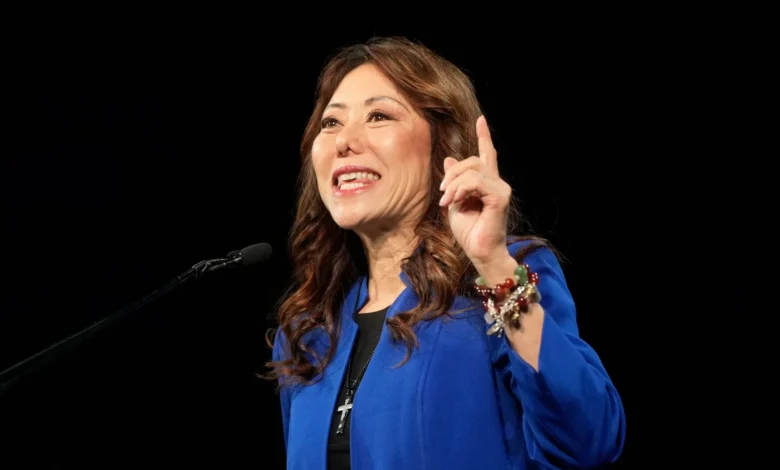
In another place and time, Fiona Ma might have been a Republican.
The former San Francisco supervisor and current state treasurer has held five different elected offices, all as a Democrat. But to hear her talk as a candidate for lieutenant governor about her priorities and how she’d handle the office, you’d be forgiven for thinking she was a Main Street conservative.
Ma says she wants the state to be more business-friendly, and she wants to go on a listening tour to find out why businesses are leaving California. She advocates the state’s universities working with corporations to bring in more funding and working with the private sector to build more student and faculty housing.
In explaining her opposition to the proposed billionaire tax, Ma echoes one of the key talking points of business groups and the ultrarich: that the measure would prompt billionaires to leave the state, leaving the state’s finances worse off, citing her private-sector experience as an accountant working for wealthy clients.
She argues that the state’s high taxes and red tape are already chasing away businesses and entrepreneurs.
“I’m more of a let’s expand the pie instead of fighting over the crumbs,” Ma told The Examiner. “If the business climate is good here in California and people are happy, and they’re able to open up a business or get a permit on time, then they’re going to stay, and they’re going to be happy to pay the taxes. However, it’s going in the opposite direction.”
Ma’s appeal to middle-of-the-road and conservative voters will get a test in November when she goes up against Gloria Romero. Formerly a Democrat who served as the majority leader in the state Senate, Romero is now a Republican who switched parties in 2024 and endorsed Donald Trump’s re-election effort that year.
In an interview with The Examiner, Ma discussed her qualifications to be lieutenant governor, what she would do in the office and why she’s not worried about running against Romero. The following conversation has been edited for length and clarity.
Why should voters vote for you for lieutenant governor? Well, I am qualified and experienced to lead on day one. But I am in public service because [of] my track record of helping people, trying to level the playing field, trying to solve problems and just make California a better place for everyone.
If you were elected, what would your priorities be? [The] lieutenant governor sits on the UC, CSU [and] community-college boards. So higher education, access to real pathways for opportunities for our young people, creating paid internships, supporting more apprenticeship programs — not only at higher-ed institutions, but pre-apprenticeship programs in our high schools — and then partnering with the private sector, trying to get the companies to invest in cooperative partnerships with the higher education institutions, as well as our young people, for those paid internships, mentorships and those pathways to good jobs.
The lieutenant governor also chairs, every other year, the State Lands Commission and the California Coastal Commission — so, protecting our environment, our public land, our oceans.
And then the lieutenant governor also is the chair of the California Economic Development Council. It really hasn’t been active the last eight years. I’m hoping that our next governor will make appointments [to the council] so we can strengthen economic-development opportunities, investor opportunities, and just keeping companies here and creating more high-paying quality jobs here in California.
If elected, it will be my fifth elected position. If you follow me on social media, I am not an office person. I really like to go out in the field to see and to listen and learn. So, I will be a very active lieutenant governor, trying to promote the businesses and the farmers and the different industries that make California the Golden State that we are.
You mentioned serving on the boards of the college systems. There’s been ongoing concerns about the affordability of higher education and, relatedly, about housing. What do you think can be done to address those concerns? As the state treasurer, I oversee the tax credit and bonds that subsidize truly affordable housing for extremely low [and] very low [income] individuals. And we have approved more applications than ever before over these past eight years.
I have experience building student housing. I’m going to continue to work with the higher-education communities to build more housing for students as well as faculty, but really encouraging the private sector also to create more housing, especially on campuses that are land-impacted, like Berkeley. It is not easy to build more housing when they don’t have a lot of land.
A lot of these universities do not have real-estate development professionals on their staff, so they have to work with outside developers — so, connecting them with the universities and also to finance, which is what I have been doing for the last eight years.
So, yes, I know that that is an issue. We are losing a lot of students if we are not going to really address this housing crisis.
Some of the issues that the universities have been having is in the past they would balance their budget by accepting more international and out-of-state students, because they pay two or three times more than in-state students. But UC and CSUs decided to change their acceptance model, where now about 85 or 90% of the students going are from within the state. And many of them [pay reduced or no tuition]. So, you can see how that impacts the budget.
The good news is some of the more creative chancellors are engaging in public-private partnerships, where they are working with companies setting up labs, like in [UC] San Diego with the biotech companies, so that they are generating not only additional revenues, but also sharing in the profits.
Not all of them are doing it, and the ones that are not able to do it [are] usually the CSUs, because they really are not set up to do that. And so, the CSU systems are the ones that are the most dependent on the general fund.
As potentially a member of the board for these higher-education institutions, do you see other ways to make college more affordable? I am an accountant and a CPA by training, and so it’s all about the numbers, right? Looking at where they’re spending the dollars, whether it is efficient and effective, and also every time you create a new program or a new curriculum, that always costs money, because you have to hire people.
So really questioning where they are focused, whether they’re spending their money wisely, whether they’re doing the proper audits — that’s where I’m going to focus on, is making them more efficient and transparent. Because that’s one of the complaints as well, is lack of transparency. That they don’t know where the money’s going, but the executives are getting paid more all the time. Yet the rank and file — the janitors or the people working in the kitchens — they’re always denied increases.
So, really looking at the finances is what I’m going to bring to the table.
If the California Economic Development Commission were to be revived, what would its priorities be? How would you lead that? What would be your goals for it? The goals are: California, we’re a very diverse state. We’re 40 million people. We’re the fourth-largest economy in the world. And not everybody understands all the different industries — what type of jobs, what type of revenues they bring in, and the different jobs and opportunities that these businesses support.
So I think, No. 1, it has to be education. I travel around. I’ve been doing this for 30 years, so I understand aerospace to gaming to agriculture. But not everybody does. I find that people and industries — they work in silos. All they care about is their own type of business, and they don’t work together to figure out what would be good goals, common goals that would help more than less. You need more people to be at the table to communicate, to come together.
I’ve done a lot of stakeholder engagement issues, [such as] changing our [minority and women-owned business enterprise] laws in San Francisco when I was on the Board of Supervisors, bringing together real stakeholders for 18 months, so that the end product was something that is usable, developed by the community, and then ultimately supported by the community, because it was derived from them versus government creating policies that don’t work and with no input from the public.
This is why people are frustrated with the state of California and they are leaving — because they don’t understand why these laws get passed. They feel like they have no input into the process. And then the only avenue for them is to either go bankrupt or close their business and move to another state. This has to stop.
So, you’re saying that if the council is revived, you would use it to try to get wide input on various regulations. Yes, and then understanding — having people sit in a room and explain what drives their industry, what is working, why they’re here in California, but what their frustrations are and challenges, and why they may not expand here in California or why they may move.
So, before they move, give us a chance to bring together these coalitions, educate each other, and, hopefully, have more understanding to support each other, instead of one industry fighting against the other industry or companies fighting against companies, billionaires fighting against other billionaires. I mean, this is not helpful
How do you plan to run against your opponent, Gloria Romero? Well, I’m running against myself. I came in first in the primary out of 16 candidates, and that’s because I do the work.
I’ve been traveling. I traveled to all 58 counties. Voters know me. I’ve been elected to four different positions where I am helping people every single day with grants and bonds and loans and just cutting through the red tape.
So, I am really making sure that voters know me, they know my track record, they know who I am, and hopefully they will continue to support and vote for me in November.
So you don’t see any need to counter Gloria at all or to address anything that she’s bringing up? Gloria’s running on a ticket with Steve Hilton, supported by the president. If you just compare and contrast the two of us, I don’t need to run against her. I just need to make sure I get my message out.