By Jason Burrell |South Bay Black Journal
The game did not end with a scheme.
It ended with a run.
When TCU running back Jeremy Payne broke three tackles in overtime to seal the Valero Alamo Bowl, the play felt less like a surprise and more like a verdict. Football, at its most honest, will always reveal what you are. On that final snap, it revealed what the USC Trojans still are not.
Physical.
Finished.
Certain.
USC’s 30 to 24 overtime loss to the TCU Horned Frogs was not decided by a clever wrinkle or a missed assignment on the perimeter. It was decided in the interior, in the place where games are either closed or conceded. Payne ran through arm tackles and hope. He ran through a defense that had the call right and the finish wrong. And when he crossed the goal line, the silence around the Trojans felt familiar.
There is a saying in the coaching profession. You are either coaching it or you are allowing it to happen.
For four seasons now, USC has allowed this to happen.
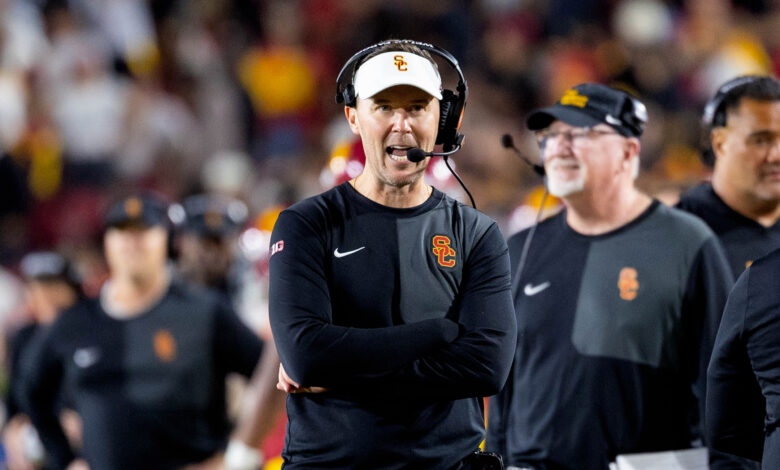
The truth in Lincoln Riley’s own words
After the game, Lincoln Riley did not hide from the moment. He named it plainly.
“We had to kick too many field goals, and they scored touchdowns in the red zone when we didn’t, and that was really the tail of the game.”
Later, when asked about the decisive sequence in overtime, Riley was even more specific.
“We did everything right defensively to put him in that position and we just didn’t finish the play.”
That sentence has followed USC for years now.
Right call. Wrong ending.
Riley acknowledged the pain in the locker room.
“It’s sad to see a lot of these guys go… but there’s just a real sense of purpose in that locker room right now.”
Purpose, however, has to translate to posture. And posture shows up in moments like third and long stops and goal-line stands. USC had chances to end this game long before overtime. Up double digits late, the Trojans failed to close. First and goal at the two-yard line, they kicked. In overtime, they tackled high and watched the night slip away.
Riley framed the season as a bridge.
“This team really gets one game together… not completely the team we played with this year and not completely the team we played with next year.”
That may be true. But bridges still require pillars. And USC’s interior, on both sides of the ball, remains hollow.
The coaching question USC can no longer avoid
This was not just a bowl loss. It was a snapshot of a program caught between ideas.
On the eve of the game, USC lost its defensive coordinator. Danton Lynn is headed to the Penn State Nittany Lions, leaving USC searching for yet another answer on defense. Riley was asked directly about the future.
“I feel fantastic… the arrows just pointing straight up.”
He emphasized opportunity.
“The opportunity to make a hire, to continue to make us better, and to go from being a very good defense to being a great defense is the goal.”
But optimism cannot erase evidence. Great defense tackle. Great defenses finish. Great defenses do not allow a running back to break three tackles on the final play of the season.
USC has talent. USC has resources. USC has a play caller who can scheme with the best in the country. What it does not have yet is a clear defensive identity that demands violence at the point of attack.
And that is coaching.
You do not accidentally become soft. You drift there when standards are suggested instead of enforced.
Credit where it belongs
This story also belongs to Sonny Dykes and TCU. The Horned Frogs stayed patient, stayed physical, and stayed connected to who they are. They ran the ball when it mattered. They tackled when it mattered. They trusted their identity when the game tightened.
TCU did not flinch.
USC did.
That difference is not about effort. It is about belief forged through repetition.
The final Call!
USC ends the season unranked. Again.
Another year without a defining win. Again.
Another loss that looks different on the scoreboard but feels the same in the body. Again.
When Jermey Payne crossed the goal line, it felt like a mirror held up to a proud program that once defined college football’s edge. The Trojans used to dictate terms. They used to finish games with force, not hope.
Now, they search.
Search for a defensive coordinator.
Search for an identity in the trenches.
Search for a way out of a hole that can no longer be explained away by youth, transition, or future promises.
There is still time for USC to change the story. But time does not reward intention. It rewards action.
Football never lies. And in San Antonio, it spoke clearly.
USC has to decide whether it wants to be coached into something new or continue allowing what everyone can already see.
The run at the end was not just a play. It was a message.
And the Trojans must finally answer it.