Inside the 72 Hours That Saved UCLA’s Season

By Jason Burrell — South Bay Black Journal
Tuesday, 5:00 p.m. The Reset Button:
When the text arrived, it wasn’t a surprise; it was confirmation. Offensive coordinator Tino Sunseri was out! And this time, nepotism didn’t work as a coaching strategy! Four games into the season, his offense ranked last in the Big Ten and near the bottom nationally in scoring. Players gathered quietly in the weight room, scrolling through headlines that felt like déjà vu.
“Another one?” one upperclassman muttered.
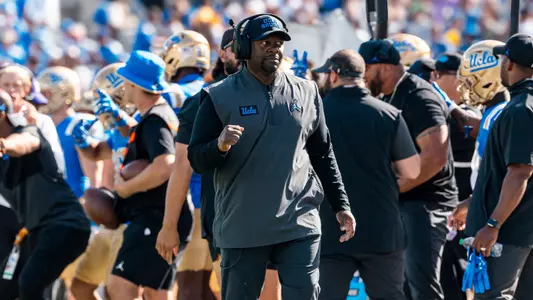
Tim Skipper, UCLA Interim Head Coach
By sunset, Jerry Neuheisel, the tight ends coach with deep UCLA lineage, was told he’d be calling plays. He had less than 72 hours to rewrite the script, literally and figuratively.
“I found out at five o’clock Tuesday,” Neuheisel said. “By six, we were already putting something together.”
Neuheisel called in veteran analyst Noel Mazzone, a former UCLA offensive coordinator known for tempo and simplicity. Together, they stripped down the playbook to essentials: pre-snap motion, quick rhythm throws, quarterback movement, and a renewed emphasis on communication.
“Jerry didn’t try to reinvent anything,” one staffer said. “He just told the players, ‘Let’s go play ball.’ It sounds simple, but that’s exactly what they needed.”
______________________________________________________________________
Wednesday, Belief Over Blueprint:
Practice felt different. No sideline tension. No eye rolls between units. Neuheisel’s first message to the team wasn’t about X’s and O’s; it was about commitment.
Quarterback Nico Iamaleava gathered the offense before drills.
“If you don’t want to be here, then leave,” he told them. “But if you still believe we can win, then let’s roll.”
The words hit home. The locker room, fractured by a month of uncertainty, started to feel aligned again. Players described the mood as “looser, but sharper.” Running backs coach DeShae Townsend reminded his group, “This is still UCLA. Don’t let the world tell you otherwise.” That afternoon, Iamaleava and Neuheisel stayed on the field after practice, walking through situational plays, two-minute, red zone, and short yardage.
“It wasn’t about memorizing a playbook,” Neuheisel said later. “It was about rhythm. About trust.”
______________________________________________________________________
Thursday, Simplify, Then Amplify:
By Thursday morning, the game plan was only about 60 percent loaded. Mazzone tweaked protection calls. Neuheisel scripted the first 15 plays himself.
“Jerry kept saying, ‘Let’s cut the fat,’” said one offensive lineman. “It felt like we finally knew what we were doing instead of thinking too much.”
Film sessions became collaborative instead of corrective. Wide receivers asked for adjustments. The O-line pushed for tempo packages. Neuheisel listened, and that listening became leadership.
Meanwhile, Garrett DiGiorgio, who had just resolved a bizarre eligibility dispute tied to his past commitment to the Naval Academy, rejoined the unit in full. “Walking back in the building and seeing the smiles on my teammates’ faces, that’s when I knew I was home,” he said.
______________________________________________________________________
Friday Night, The Calm Before the Clarity:
Team meetings were shorter. No rants, no panic. Neuheisel kept it light. “We’ve already been through the hard part,” he told them. “Now go have fun.” Nico Iamaleava later said that his speech changed everything.
“It felt like we were finally playing for something again, not through something.”
Players described a quiet confidence at the hotel that night. No headphones. No staring at phones. Just conversation, laughter, and, for once, peace.
______________________________________________________________________
Saturday, Freedom, Finally:
From the opening kickoff, UCLA played like a team that had unclenched its fists. A 10–0 first-quarter lead set the tone. Iamaleava threw with conviction, ran with confidence, and when Neuheisel’s headset glitched mid-game, he simply took over.
“A couple times, I just called my own play,” Nico said with a grin. “Coach Jerry forgot to hit the button.”
When the final whistle blew, UCLA 42, Penn State 37, the Rose Bowl exhaled. The team didn’t celebrate like underdogs. They celebrated like they knew they belonged.
______________________________________________________________________
Aftermath: A Program in Transition, A Locker Room Reborn:
For 72 hours, the Bruins did what the administration couldn’t: find direction. Neuheisel’s offense wasn’t perfect, but it was purposeful, effective, and productive. Players called it “free,” “fun,” and “focused.” “We finally played without fear,” said DiGiorgio. “That’s what football’s supposed to be.”
What’s Next:
UCLA’s win over Penn State doesn’t erase the chaos of the past month, but it exposes something undeniable, these players never quit!
The next step is sustainability. Neuheisel has earned the right to finish the season calling plays, and the administration must decide whether stability is finally worth protecting. Because for 72 hours, UCLA found what it’s been missing for years: clarity, unity, and belief.